
Cheap houses in Greece are mostly found in the north-west and inland north, where Spitogatos asking prices in Q2 2026 started at €585 per m² in Kastoria. Low prices usually come with a reason: renovation needs, poor energy performance, unlicensed additions or difficult access. This guide shows where prices are lowest, what “cheap” tends to mean in practice and what to check before you buy.
Last checked: October 2026
At a glance
- The five cheapest areas for asking prices in Q2 2026 were Kastoria (€585 per m²), Florina (€673), Kozani (€682), Kilkis (€707) and Karditsa (€741), Spitogatos data show.
- Asking prices across Greece rose 6.1% a year in Q2 2026, so cheap areas are not standing still.
- Kastoria, Florina and Kilkis are designated border areas, where buyers who are not EU or EFTA citizens need prior permission under Law 1892/1990.
- The current renovation grant targets existing owners, with homes whose building permit dates from 1990 or earlier, and bars short-term letting for five years.
- A cheap house will rarely meet Golden Visa rules: the €400,000 tier needs a single property of at least 120 m².
Where to find cheap houses in Greece
The lowest asking prices are in western Macedonia, central Macedonia’s inland units and Thessaly. Spitogatos publishes average asking prices per m², not sale prices, so treat them as a guide to where to look.
According to the Spitogatos Q2 2026 report, published on 4 August 2026, these were the cheapest regional units for homes for sale:
| Regional unit | Average asking price, Q2 2026 |
|---|---|
| Kastoria | €585 per m² |
| Florina | €673 per m² |
| Kozani | €682 per m² |
| Kilkis | €707 per m² |
| Karditsa | €741 per m² |
At the other end, the south suburbs of Athens averaged €4,231 per m² and the Cyclades €4,063. For a national picture, see our Greece house prices page.
Cheaper corners of Athens, Thessaloniki and the islands
Cheap does not only mean remote. The same Spitogatos release lists lower-priced areas inside the two big cities.
| Area | Average asking price, Q2 2026 |
|---|---|
| Varnavas (Attica) | €1,407 per m² |
| Agia Varvara (Attica) | €1,500 per m² |
| Perama (Attica) | €1,688 per m² |
| Mygdonia (Thessaloniki) | €938 per m² |
| Kallithea (Thessaloniki) | €1,092 per m² |
| Vasilika (Thessaloniki) | €1,167 per m² |
Among islands, the Spitogatos islands report of 16 September 2026 shows the North Aegean as the lowest-priced group: Samos €1,059 per m², Lesvos €1,136, Chios €1,533 and Ikaria €1,846. All four rose on the year. In Crete, Lasithi was lowest at €1,944 per m².
Samos, Lesvos and Chios are also designated border areas, so the permission rule below applies there too.
What “cheap” usually means
A low price per m² usually reflects work the buyer will have to do or a risk the buyer will carry.
Renovation
Many low-priced homes are older village houses that have stood empty. Roofs, damp, wiring and plumbing are the usual costs.
Energy performance
A sale of a home usually needs an energy performance certificate. Older stone and concrete houses often have poor ratings, which means higher heating and cooling bills. The certificate tells you the starting point.
Illegal works
Extra rooms, enclosed balconies and roof additions are common in older Greek houses. No sale can go ahead without the property’s electronic identity (ilektroniki taftotita akinitou), drawn up by a licensed engineer, which covers illegal works. Our guide to illegal building works explains the rules.
Access and title
A house at the end of a dirt track can be hard to reach in winter and costly to connect to services. Old village houses are also often inherited by several co-owners, all of whom must sign. Check the Cadastre record early; our guide to Cadastre checks before buying explains how.
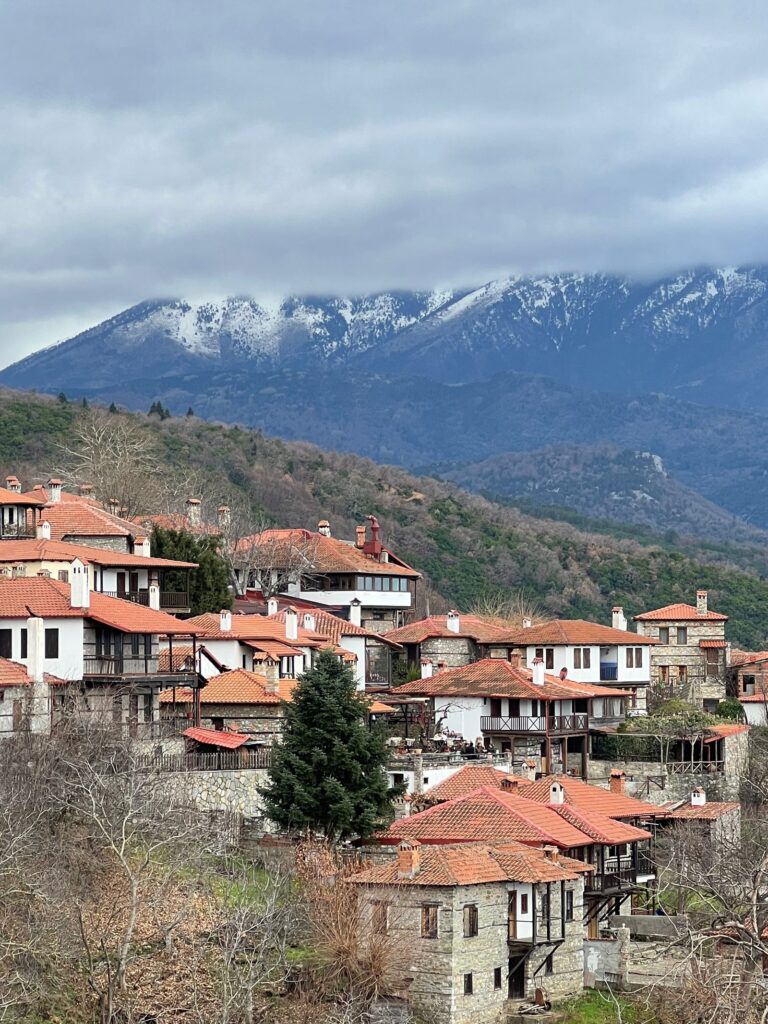
Stone houses in Greece
A stone house in a traditional settlement can be a good buy, but extra rules may apply. Listed buildings and traditional settlements limit what you can change. Under articles 374, 405 and 406 of the Spatial Planning–Urban Planning Code, Law 5306/2026 (ΦΕΚ Α’ 88/08.06.2026), unauthorised works on a listed building or in a traditional settlement can be legalised only through a special procedure that needs the approval of an architecture council or committee, which may require adaptation works. A licensed engineer can confirm which permits a restoration needs.
Renovation grants: what is available
Greece’s current renovation grant is built for people who already own and use a home, so it rarely helps a new buyer. Its terms can still affect a house being sold.
The programme is called Home Renovation (Anakainisi Katoikias). Its rules are set by joint ministerial decision 86272 ΕΞ/2026 (Government Gazette B’ 3058, 2 June 2026), as later amended:
- Eligible homes have a building permit issued up to 31 December 1990, or equivalent proof, and up to 120 m² of main space (150 m² for families with three or more children), an energy performance certificate rating of C (Γ) or lower, and no entry in AADE’s short-term rental registry.
- The grant covers up to €300 per m² including VAT, so €36,000 for a 120 m² home.
- Subsidy rates run from 70% to 95% of costs, depending on income band and add-ons.
- Empty homes must pass electricity-use tests for 2024 and 2025 and be declared empty on the 2025 E2 form. Lived-in homes must be the owner’s main residence on the 2025 tax return.
- For five years after completion, a home that was empty must be let as a main residence and a lived-in home must stay owner-occupied. Short-term letting, business leasing and subletting are banned, and transferring the home within five years means repaying the full grant.
Two lessons follow for buyers. The scheme’s tests look at the home’s use in 2024 and 2025 and the applicant’s 2025 tax return, so they are built around existing owners. And if a seller’s house is in the scheme, a sale within five years triggers repayment, which must be settled before completion.
The €10,000 relocation grant
A separate grant of €10,000 per household supports people who move their main home to 11 northern and border regional units, including Kastoria, Florina, Kilkis and Kozani. Under decision 22695 (Government Gazette B’ 6139, 9 October 2026), the applicant must be an adult Greek citizen, places are capped at 1,000 households and the programme runs no later than 31 December 2028. It is not for foreign investors, and article 6(β) of the decision requires the household’s main home in the previous three years to have been in a Greek municipality of origin as defined in article 5 (outside the regions of Epirus, Western Macedonia, Eastern Macedonia and Thrace, the North Aegean and the South Aegean) or in another EU member state, so Greeks returning from outside the EU, such as from the US, Canada or Australia, do not qualify. See our report on the relocation grant rules.
Golden Visa and cheap houses
Most cheap houses will not qualify for a Golden Visa on their own. The lowest standard tier needs a bigger and more expensive single property than most bargain listings.
Under Article 100 of Law 5038/2023, as amended by Law 5100/2024, according to the Ministry of Migration and Asylum’s circular:
| Tier | Where | Main condition |
|---|---|---|
| €800,000 | Attica, the Thessaloniki regional unit, the Mykonos and Thira (Santorini) regional units, and islands with more than 3,100 residents | Single property of at least 120 m² |
| €400,000 | The rest of Greece | Single property of at least 120 m² |
| €250,000 | Anywhere | Conversion of commercial space to housing, or restoration of a listed building |
The €400,000 tier covers areas such as Kastoria, Karditsa, inland Peloponnese and Halkidiki. Large islands such as Lesvos, Chios and Samos fall in the €800,000 band because they have more than 3,100 residents. For smaller islands, the tier depends on whether the population exceeds 3,100.
The €250,000 route for a listed building has no minimum surface, and full restoration must be completed before the first renewal, according to the same circular. It can fit a listed stone house, but the restoration budget comes on top. Our Golden Visa guide covers the rest of the rules.
Border areas: one extra step for non-EU buyers
Several of the cheapest areas are designated border areas, where non-EU and non-EFTA buyers need prior permission. Under Article 24 of Law 1892/1990, as replaced by article 114 of Law 3978/2011, these include the prefectures of Kastoria, Florina, Kilkis, Evros, Lesvos, Samos, Chios and the Dodecanese. Permission is decided by a committee at the competent Decentralised Administration.
Checklist before buying a cheap house in Greece
- Compare the asking price with Spitogatos data for the area and with recent local sales your lawyer can find.
- Get a builder’s quote for the roof, damp, wiring, plumbing and insulation.
- Read the energy performance certificate.
- Have your own engineer review the electronic identity and the building permit.
- Check the Cadastre record and confirm every co-owner will sign.
- Check road access and the cost of water, power and drainage connections.
- Ask whether the house is in a renovation grant scheme.
- If you are a non-EU buyer, check for border-area permission.
For the full purchase process, see how to buy property in Greece as a foreigner.
Thinking about buying a house in Greece on a budget? Give your brief to an independent buyer’s agency. It can search the market for exactly what you are looking for and advise you through the purchase.
Frequently asked questions
Where are the cheapest houses in Greece?
In Q2 2026, Kastoria had the lowest average asking price at €585 per m², followed by Florina, Kozani, Kilkis and Karditsa, Spitogatos data show.
Can I buy a house in Greece for €50,000?
In the cheapest regional units, asking prices suggest a small older house can be listed near that level. At Kastoria’s average of €585 per m², an 80 m² home would be listed at about €46,800. Renovation costs come on top.
Are cheap Greek houses a good investment?
They can be for personal use, but resale and rental demand in remote areas are thinner.
Can a foreigner get a renovation grant in Greece?
The current Home Renovation grant is aimed at existing owners. Its tests look at the home’s use in 2024 and 2025 and the 2025 tax return, so they are built around existing owners, and short-term letting is banned for five years after the works.
Does a cheap house qualify for the Golden Visa?
Usually not. The €400,000 tier needs a single property of at least 120 m². A listed building restored under the €250,000 route is the main exception.
Do buyers from outside the EU and EFTA need permission to buy in northern Greece?
In designated border areas, yes. Kastoria, Florina and Kilkis are among them, under Law 1892/1990.
Buyers should confirm how this applies to them with a Greek lawyer or accountant.
Sources
- Spitogatos: home sales and rents, Q2 2026 (4 August 2026)
- Spitogatos: Greek islands, Q2 2026 (16 September 2026)
- Joint ministerial decision 86272 ΕΞ/2026, Government Gazette B’ 3058/02.06.2026 (Greek)
- Ministry of Social Cohesion and Family: joint ministerial decision on the relocation grant
- Ministry of Migration and Asylum: Golden Visa circular on Law 5100/2024 (Greek)