
Sponsored content, written by the GreekProps editorial team under our editorial policy. Sponsor: Santheos.
A residential conversion turns a building with another use, such as shops or offices, into homes. For buyers from outside the EU it is also one route to Greece’s Golden Visa at €250,000, instead of €400,000 or €800,000. The lower threshold comes with paperwork that an ordinary purchase does not have. These are seven checks to run before you sign.
Last checked: November 2026
The permit for the change of use
Under Article 199 of the Spatial Planning–Urban Planning Code (Law 5306/2026), a building’s use may change only if the planning rules for the area allow the new use. The Code also makes conditional exceptions for turning certain legally existing buildings into homes where the area’s land uses would not otherwise allow it.
A building permit is needed when the change is for the worse in the figures of the building diagram or in the structural design loads, or alters how mechanical installations pass through other floors or shared areas. For a space that already has a building permit for a specific use, a change of use that triggers none of these needs no new building permit, but the electronic property identity (see check 6) must be updated. The exceptions above fall outside this rule. The works are assessed separately under Article 315: depending on their nature and scope, they may need a small-scale works approval or a building permit.
The procedure is electronic. Permits and approvals are issued on electronic submission, and their numbers are posted online (Articles 319, 323 and 324). The system, e-Adeies, is hosted by the Technical Chamber of Greece (TEE), whose page links a public search.
Ask the developer for the number of the permit or approval that covers the change of use, and of any revision. Your own licensed engineer can then compare its scope with what is being built.
Title, and the flat as a separate property
Under the Civil Code, separate ownership of a flat can be created only by a legal act of the owner of the whole property (Article 1002). Ownership passes by a notarial deed that is registered (Article 1033).
The Hellenic Cadastre identifies a unit by the property’s code number (KAEK) together with its vertical and horizontal numbers. A copy of the cadastral sheet shows the registered rights and any encumbrances or lawsuits. The buyer’s lawyer can search the records remotely through the Cadastre’s services for lawyers.
Where one commercial building becomes several flats, ask whether the deed that creates the separate flats has been signed and registered, and which unit is yours.
Progress and delivery
Works carried out under a building permit are inspected on site by building controllers (Article 331 of the Code). After a final inspection with no violations, the municipal building service issues the construction control certificate (PEK), and connection to the utility networks follows it (Articles 333 and 334).
Ask the developer for the stage reached today, the delivery date written into the contract, and what happens if that date slips.
Sponsor’s project: Project Artemida ST-026
Santheos describes itself as a commercial-to-residential conversion developer in Athens. Its project page lists Project Artemida ST-026, at Konstantinou Karamanli 52–60 in Artemida, as a commercial-to-residential conversion that is under construction. Santheos states that the project is largely sold out and that the availability of specific units must be confirmed directly with the company. It expects delivery by the end of 2026, subject to progress; this is not a guaranteed completion date.
Artemida is a coastal town in the Municipality of Spata–Artemida, in East Attica. Santheos describes its projects, including Artemida ST-026, as commercial-to-residential conversions intended for the €250,000 conversion route described in check 7, not for the general location-based thresholds. Eligibility on that route depends on the applicable law, the specific property and the investor’s circumstances, and is subject to independent legal verification; it is not a guarantee of a residence permit.
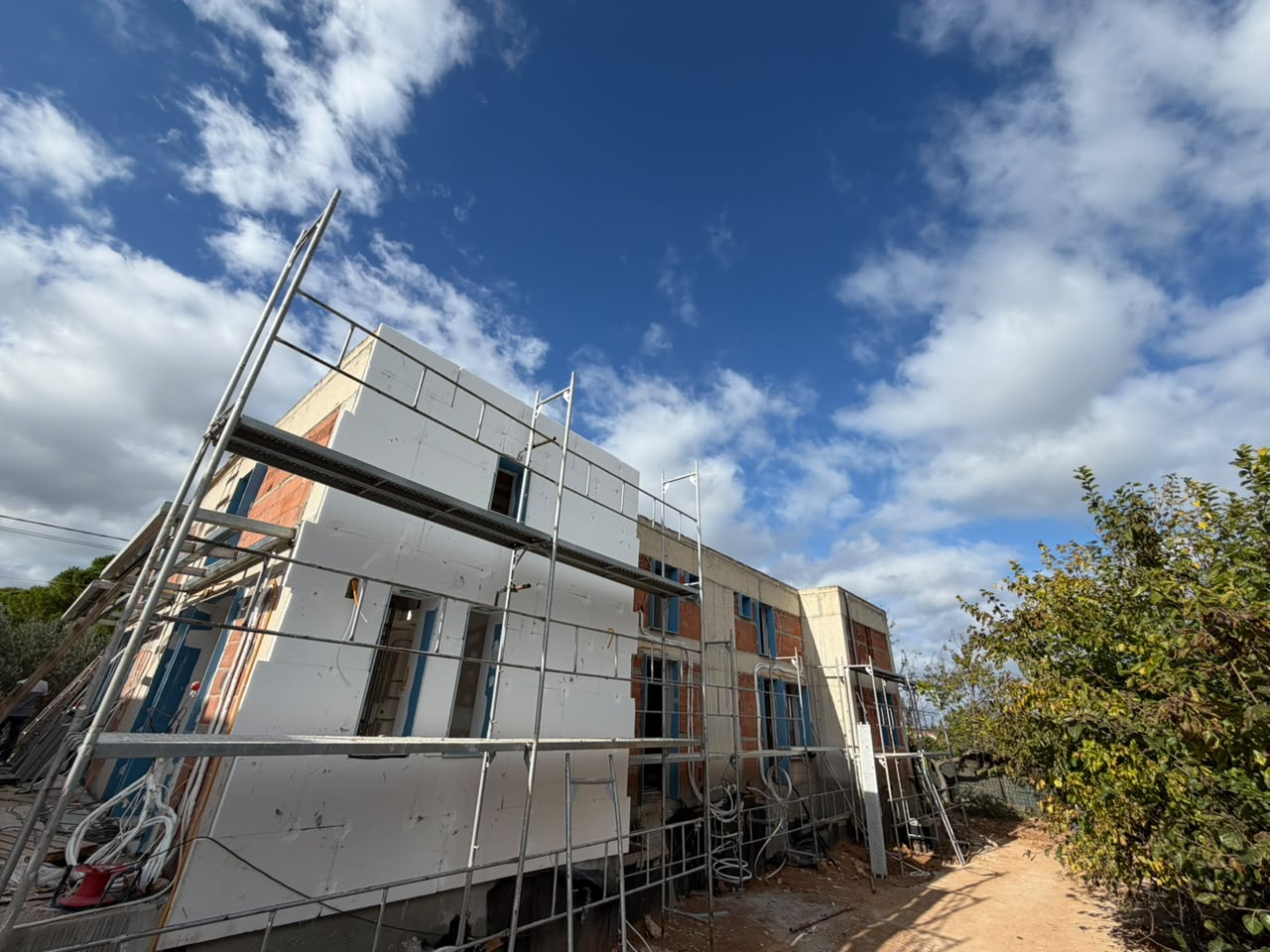
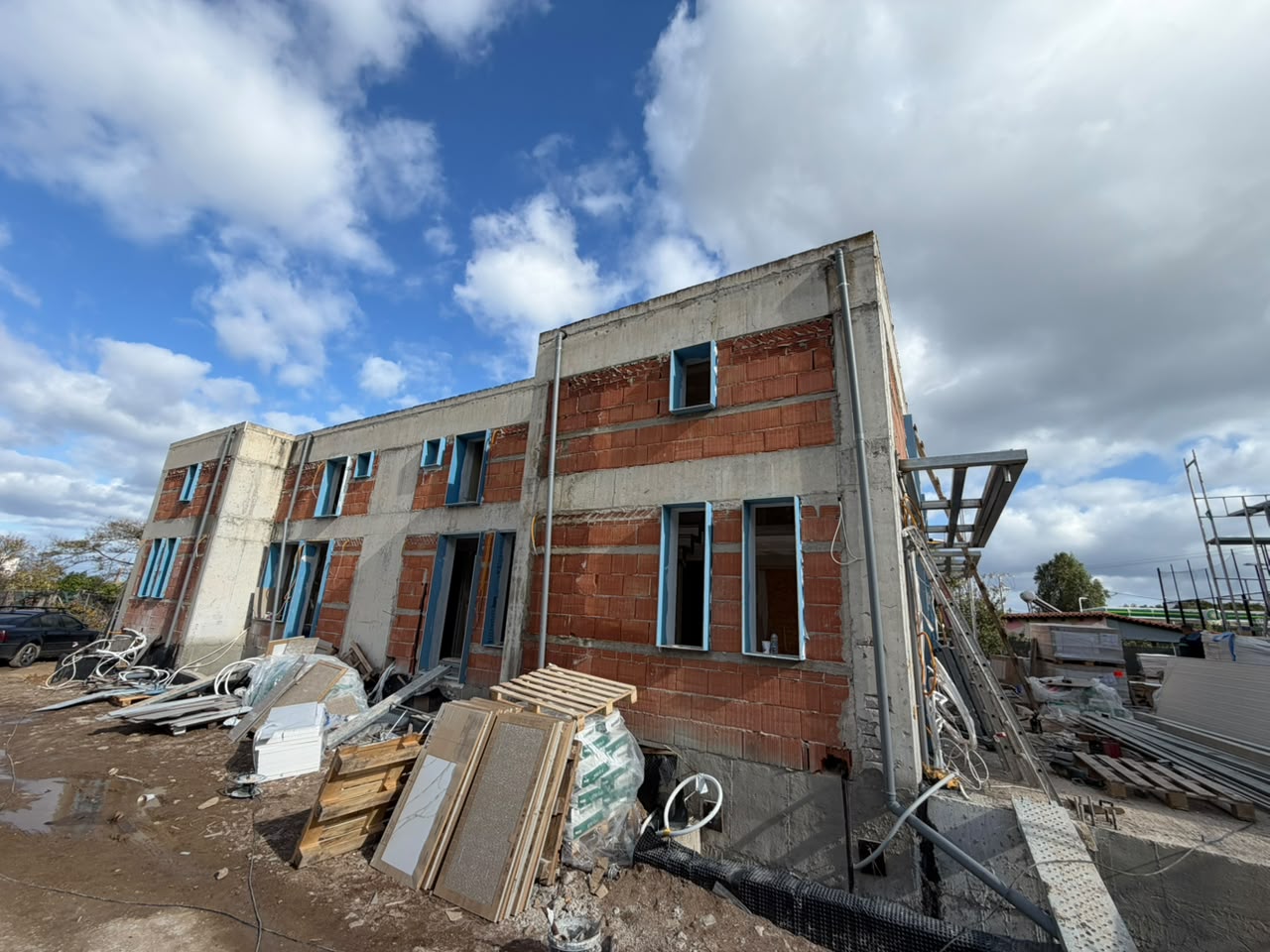
Project Artemida ST-026: construction works in progress. Images supplied by Santheos. The photographs show one moment on site; they are not evidence of the current stage or of completion.
Specification and availability
Ask for a written specification attached to the contract: the floor area of main and ancillary spaces, materials, heating and cooling, parking and storage. An energy performance certificate (EPC) is required for a sale. For a sale before completion, the seller gives an estimate of the building’s future energy performance, under Article 12 of Law 4122/2013.
Unit availability changes. Confirm it in writing before you pay a reservation.
Price, tax and payments before the deed
A preliminary contract to buy property must be signed before a notary (Civil Code, Articles 166 and 369). Where earnest money (arravonas) is paid, the party at fault for the contract not being performed loses the amount it paid, or returns double the amount it received (Article 403).
Ask what the contract provides for stage payments made before the final deed, and what secures them: a bank guarantee, an escrow arrangement, or payments tied to stages that can be verified. Our off-plan checks go through the options.
Under the general rule, transfer tax is 3% of the taxable value plus a 3% municipal surcharge on the tax, or 3.09% in total, and the buyer pays it, according to AADE, the tax authority. A new building sold by its builder can instead carry 24% VAT, which builders can have suspended until 31 December 2027 under Article 70 of the VAT Code, as amended by Article 17 of Law 5355/2026. The contract should state which of the two applies to the unit.
From 1 July 2027 the rate is higher for some buyers. Law 5355/2026 (Government Gazette A’ 188/13.11.2026) sets transfer tax at 15% on a home bought by an individual who is tax resident outside the EU and the European Economic Area at the time the tax obligation arises. Article 27 of the Property Tax Code charges the 3% municipal surcharge on all transfer tax due under that article, which brings the total to 15.45% of the taxable value. Buyers entitled to the first-home exemption in Article 42 of the Property Tax Code are not covered. Under Article 53(8) of the law, the 15% rate applies to final contracts signed from 1 July 2027. Article 26 of the Property Tax Code provides that, where a notarial preliminary contract is followed by the final contract within two years, the tax is calculated at the rates in force when the preliminary contract was signed. Neither the law nor its explanatory report says how the two rules apply to a preliminary contract signed before 1 July 2027. Buyers should confirm how this applies to them with a Greek lawyer or accountant.
The papers the notary needs
A change of use made without the required building permit is an unauthorised change of use (Article 366 of the Code). The transfer of a property with unauthorised construction or an unauthorised change of use is prohibited and void, subject to the exceptions listed in Article 367.
The electronic property identity (ilektroniki taftotita akinitou), which the Code calls the electronic identity of a building or of a separate unit, is updated after any works that needed a permit or approval (Article 343). For the sale, a licensed engineer issues its certificate of completeness. It is attached to the deed and is valid for two months, under ministerial decision ΥΠΕΝ/ΔΕΣΕΔΠ/7577/105/2021.
The Golden Visa test
The investor residence permit for property owners is set out in Article 100 of the Migration Code (Law 5038/2023), as replaced by Article 64 of Law 5100/2024. The law sets two kinds of threshold. The general thresholds depend on location: €800,000 in Attica, the Thessaloniki regional unit, the regional units of Mykonos and Thira (Santorini) and islands with more than 3,100 residents, and €400,000 elsewhere, in both cases for one property of at least 120 m². Our Golden Visa guide covers these tiers.
The special conversion route is separate and applies wherever the property is: the minimum is €250,000 where the main areas of the property bought change to residential use. Eligibility depends on the applicable law, the specific property and the investor’s circumstances, and is subject to independent legal verification; meeting the threshold is not a guarantee of a residence permit. The conditions come from the law, the Ministry of Migration and Asylum’s circulars and the joint ministerial decision on supporting documents:
- The investment is in one property only. The 120 m² minimum does not apply.
- The change of use is completed on or after 5 April 2024 and before the permit application is filed. Either the seller or the buyer may carry it out.
- A licensed engineer’s technical report certifies the change, citing the building permit, small-scale works approval, file update or permit revision.
- The applicant holds the property in full ownership and possession. The price is paid in full before the application, by crossed bank cheque, credit transfer or card.
- The home may be let. Short-term letting and subletting in the sharing economy are banned. The Ministry’s Circular 1/2026 says the ban concerns only these, as defined in Article 111 of Law 4446/2016. That article defines a short-term lease as a lease or sublease of under 60 days with no services beyond accommodation and bed linen, whether or not the property is listed on a digital platform.
- A property bought on the conversion route may not serve as the seat or branch of a business. A breach of either rule means revocation of the permit and a €50,000 fine.
The €250,000 route works once for each property. Circular 1/2026 states that if a converted home is resold to another third-country national after a permit has been granted on it at €250,000, the new buyer cannot use the €250,000 threshold and must meet the €400,000 or €800,000 tier. This matters both when buying a resale and when selling later.
The permit runs for five years and can be renewed while the owner keeps the property. Eligibility is decided on the specific property and the applicant’s file. Buyers should confirm how this applies to them with a Greek lawyer or accountant.
This is sponsored content. Project information was supplied by Santheos or taken from its public project page and has not been independently verified by GreekProps. The article explains published rules; it is not legal, tax or investment advice.
Sources
- Spatial Planning–Urban Planning Code, Law 5306/2026 (Government Gazette A’ 88/08.06.2026), Articles 199, 315, 319, 323, 324, 331, 333, 334, 343, 366 and 367 (Greek)
- Technical Chamber of Greece: e-Adeies electronic permit system (Greek)
- Civil Code, Articles 166, 369, 403, 1002 and 1033 (Greek)
- Hellenic Cadastre: services for lawyers (Greek)
- Law 4122/2013, Article 12: energy performance certificate
- AADE: property transfer tax (Greek)
- Law 5355/2026 (Government Gazette A’ 188/13.11.2026), Articles 16, 17 and 53 (Greek), with the Property Tax Code (Law 5219/2025), Articles 26, 27 and 42, and the VAT Code (Law 5144/2024), Article 70
- gov.gr: certificate of completeness of the electronic building or property identity (Greek), under ministerial decision ΥΠΕΝ/ΔΕΣΕΔΠ/7577/105/2021 (Government Gazette B’ 334/29.01.2021)
- Migration Code, Law 5038/2023, Article 100, as replaced by Article 64 of Law 5100/2024 (Greek)
- Ministry of Migration and Asylum: Circular 9/2024 and Circular 1 of 21 April 2026 on Article 100 (Greek)
- Joint Ministerial Decision 214926/2025 (Government Gazette B’ 6014/11.11.2025) on supporting documents (Greek)
- Law 4446/2016, Article 111: short-term leases in the sharing economy
- Law 3852/2010: Municipality of Spata–Artemida, Region of Attica
- Santheos: public project page for Project Artemida ST-026, read on 14 November 2026
- Santheos: project status supplied by the company, 17 November 2026